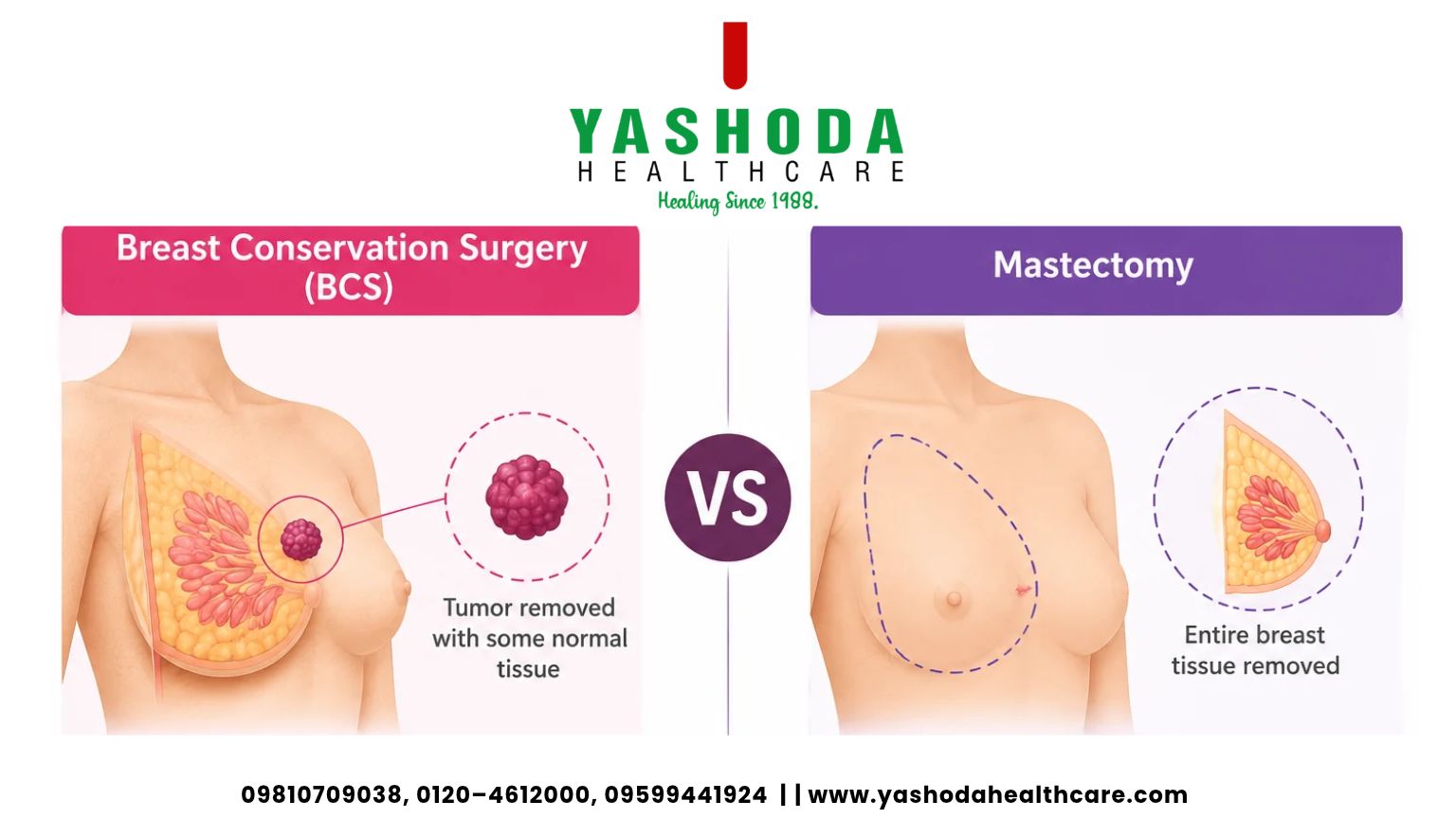
Breast cancer treatment involves several surgical options, and choosing the right procedure depends on the patient’s medical condition, cancer stage, tumour size, and personal preferences. Two commonly performed surgical procedures for breast cancer are Breast Conserving Surgery (BCS), also known as lumpectomy or partial mastectomy, and full mastectomy.
But what makes Breast Conserving Surgery a preferred option for some patients? Who is eligible for this procedure, and when might a full mastectomy be recommended? Let’s understand the differences between these procedures and how to choose the right treatment.
What is Breast Conservation Surgery (BCS)?
Breast Conserving Surgery (BCS), also known as lumpectomy or partial mastectomy, is a surgical procedure in which the cancerous tumour, along with a small margin of surrounding healthy breast tissue, is removed while preserving most of the breast.
The primary objective of Breast Conserving Surgery is to remove the cancer from the affected breast while retaining as much natural breast tissue as possible. This approach helps preserve the breast’s appearance and can be an effective treatment option for eligible patients with breast cancer.
Benefits of Breast Conservation Surgery (BCS)
Breast Conserving Surgery offers several benefits compared to full breast removal. Some of its major advantages include:
- Preserves Natural Breast Appearance: One of the biggest advantages of BCS is that it preserves most of the natural breast. This can help maintain the patient’s body image, confidence, and self-esteem.
- Less Extensive Surgery: Since only the tumour and a surrounding margin of tissue are removed, the surgical procedure is generally less extensive than a full mastectomy. Recovery may also be easier for eligible patients.
- Combined with Radiation Therapy: Breast Conserving Surgery is commonly followed by radiation therapy to reduce the chances of cancer recurrence in the treated breast.
Although Breast Conserving Surgery directly removes the tumour while preserving most of the breast, it may not be suitable for every patient. Cancer recurrence remains a possibility, and some patients may require additional treatment.
BCS may not be recommended in certain situations, such as when there are multiple tumours in different areas of the breast, when the cancer cannot be completely removed with clear margins, or when radiation therapy is not suitable. Patients with advanced breast cancer may also require a different treatment approach depending on the extent of disease and response to initial treatment.
What is Mastectomy?
Mastectomy is a surgical procedure that involves removing the entire breast tissue. Depending on the extent of the cancer, the surgeon may also remove some lymph nodes located near the breast.
It is a more extensive surgical approach and may be recommended for patients with multiple tumours, larger tumours relative to breast size, or certain aggressive or advanced forms of breast cancer.
Mastectomy can also be performed as a preventive procedure in individuals who have a significantly increased risk of developing breast cancer.
Benefits of Mastectomy
A full mastectomy may offer several advantages in specific clinical situations. These include:
- May Reduce the Need for Radiation Therapy: Depending on the cancer stage, lymph node involvement, and other risk factors, some patients may not require radiation therapy after mastectomy.
- Lower Risk of Cancer Recurrence in the Breast: Removing the entire breast tissue reduces the risk of cancer developing again in the remaining breast tissue compared with breast-conserving surgery. However, it does not eliminate the possibility of recurrence completely.
- Suitable for Certain Complex Cases: Mastectomy may be a more appropriate option when the cancer involves multiple areas of the breast or cannot be adequately removed through breast-conserving surgery.
- Reduced Need for Routine Mammograms of the Operated Breast: After a complete mastectomy, routine mammograms of the removed breast are generally not required. However, follow-up examinations and imaging of the remaining breast may still be necessary.
- Breast Reconstruction Options: Patients can consider breast reconstruction after mastectomy to restore breast shape and appearance. Reconstructive procedures can help support body image and confidence after surgery.
Breast Conserving Surgery (BCS) vs Mastectomy: Which Surgery Should You Choose?
Choosing between Breast Conserving Surgery (BCS), also known as lumpectomy, and a full mastectomy depends on several medical and personal factors.
Some of the important considerations include:
- Size of the Tumour: The size of the tumour in relation to the overall breast size plays an important role in determining whether breast conservation is possible.
- Extent and Stage of Cancer: The stage of breast cancer, its spread within the breast, and whether it has reached the lymph nodes or other parts of the body influence the choice of surgery.
- Patient’s Medical Condition and Preferences: The patient’s overall health, treatment expectations, personal preferences, and family considerations should be discussed with the treating medical team.
- Suitability for Radiation Therapy: Breast-conserving surgery is generally followed by radiation therapy. Therefore, the patient’s ability and willingness to undergo radiation treatment are important considerations.
After evaluating these factors and examining the tumour, the patient, family members, and treating doctors can discuss the most appropriate surgical option.
While lumpectomy generally involves a smaller surgical procedure and preserves most of the natural breast, advances in surgical techniques and breast reconstruction have also made recovery and rehabilitation after mastectomy more patient-friendly.
Ultimately, neither procedure is universally better. The right choice depends on the patient’s individual diagnosis, medical requirements, and treatment goals.
Best Hospital and Doctors for Breast Cancer Treatment and Surgery in Delhi NCR(Noida, Ghaziabad)
At Yashoda Superspeciality Hospital & Cancer Institutes, Sanjay Nagar, Ghaziabad, we provide a onestop breast health service and breast cancer care centre network with a personalised and multidisciplinary comprehensive treatment for any kinds of diseases or cancers associated with the breasts. Our network of breast cancer specialists, interventional radiologists, surgical oncologists and onco-reconstructive surgeons are well-equipped with decades of experience in the field of breast cancer oncology.
Dr. (Surg Lt Cdr) Anushree Vartak is the Director, Breast Surgical Oncology & Oncoplastic Surgery at Yashoda Hospital, Sanjay Nagar, Ghaziabad. She specialises in all kinds of breast diseases including the most benign and malignant breast cancers, breast cancer surgeries and breast oncoplastic surgeries. Formerly in the Indian Armed Forces, Dr. Vartak possesses over 12 years of experience in the field of breast cancer. Her evidence-based approach in the management of benign breast diseases and comprehensive management of breast cancer speaks volumes of her expertise and passion in the field.
Dr. (Col.) N. Chakravarty is the Director of Radiation Oncology with us. He comes with an experience of over three decades in the field of radiation oncology. Following his years of dedication and service, he has been bestowed with the honour of being the Chief of Army Staff (COAS) Commendation.
Dr. Prof. (Col.) Mohammed Alam Parwaz is the Director, Plastic, Reconstructive & Cosmetic Surgery at Yashoda Hospital, Sanjay Nagar, Ghaziabad. Formerly at various esteemed positions in the Indian Armed Forces, he possesses an indelible experience in the field of plastic and reconstructive cancer surgeries of more than three decades.
For bookings or appointments, feel free to reach out to us at the given toll-free number – 9810709038/0120-4612000.